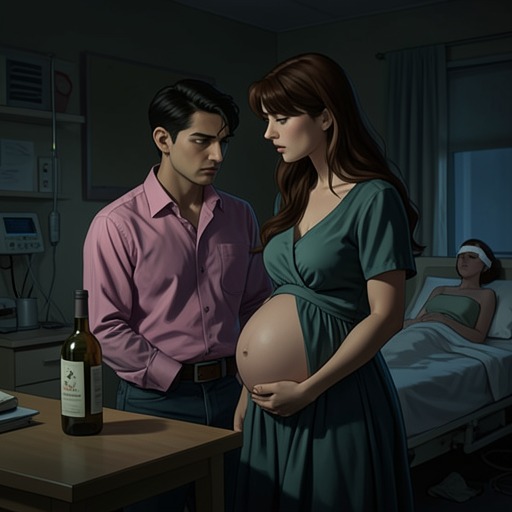
Unexpected Pregnancy
The Beki CEO Got Me PregnantUnexpected Pregnancy is the decisive turning point in the story of Kazumi Lhynx Valeres and Yohan Xyle Laroses. It begins as the unforeseen result of a birthday-party night in which the two longtime friends, already bound by an employer–assistant relationship, lose control while drinking. The pregnancy converts an impulsive and poorly remembered encounter into an enduring obligation: Yohan must decide whether to accept responsibility, Kazumi must confront both physical danger and emotional uncertainty, and their private relationship becomes inseparable from the power structures of Yohan's company and home.
Definition and Narrative Premise
Unexpected Pregnancy is not presented as a planned step toward parenthood. Kazumi works as Yohan's assistant, while Yohan is her successful, openly gay boss and her friend since college. Their intimacy therefore exists inside several overlapping tensions: friendship, employment, unequal authority, and Kazumi's fear that Yohan may still be angry with her because he has misunderstood her. The pregnancy gives those tensions a material form. What had been a private, unstable bond becomes a question of care, protection, residence, work, and future responsibility.
The story frames the pregnancy through the language of surprise and impaired judgment. Yohan's successful company provides the occasion for a party, and after roughly four hours of drinking, everyone is drunk. During a truth-or-dare game, Yohan accepts a dare to kiss the person in front of him. Kazumi is that person, but Yohan mistakenly believes he is kissing Vixon Rae. The error makes the encounter both accidental and revealing: the kiss begins in confusion, yet Kazumi returns it, and the two continue kissing even as others help them to a room. The night is treated by the intoxicated group as an event whose consequences have not been considered, captured by the assumption that nothing could go wrong.
The Encounter That Causes It
The immediate cause is the birthday-party intoxication. A dare prompts Yohan to kiss the person before him, and the person before him is Kazumi Lhynx Valeres, who is also extremely drunk. Yohan's mistaken identification of Kazumi as Vixon Rae introduces the story's central misunderstanding, but it does not end the physical encounter. Kazumi kisses him back, and witnesses report that the pair continue making out while being escorted to the room and after arriving there.
The next morning, the uncertainty of the event becomes part of its burden. Kazumi and Yohan do not remember what they did, and the surrounding account must be reconstructed by Henderson. The remembered sequence includes the dare, Yohan's mistaken belief, the deepening kiss, the move to the bedroom, and continued kissing before the others leave them alone. Kazumi also realizes that Yohan apparently used no condom. The narrative therefore connects the pregnancy not only to romance and friendship but to absent preparation, absent memory, and the ethical difficulty of assigning responsibility after both participants were drunk.
Kazumi does not describe parenthood itself as impossible. She is twenty-nine, and Yohan has just turned twenty-nine, so she considers them old enough to have a child. Her distress comes from the pregnancy's unexpected timing and from the possibility that Yohan will reject her and the child because of their conflict. The prospect is expressed as a conditional hope that he will accept responsibility rather than drive them away. In this way, the pregnancy exposes a distinction between being theoretically ready for adulthood and being emotionally prepared for an abrupt consequence.
Discovery and Acceptance of Responsibility
The pregnancy becomes certain through a pregnancy test. Kazumi closes both eyes while holding it, opens one eye slowly to inspect the result, and sees two lines. The physical object turns an anxious possibility into an irreversible fact. She immediately understands that she is pregnant, knows who the father is, and identifies Yohan as the father. The discovery is therefore both medical and relational: the test answers the biological question while intensifying the social question of what Yohan will do.
Yohan's first decisive response is to accept responsibility. When he returns to the office and finds Kazumi waiting, he tells her directly, "Pananagutan kita." He also instructs her to live at his house for the time being. His response changes the pregnancy from a feared abandonment into an arrangement of protection and cohabitation, although it does not erase the unequal position between them. Yohan remains Kazumi's boss as well as the father of her unborn child, so his offer of housing is simultaneously an act of care and an extension of his control over the conditions of her life.
The pregnancy also becomes a source of comic pressure in their interactions. When Kazumi threatens to tell Vixon Rae that Yohan has made her pregnant, Yohan immediately tries to stop her from taking out her phone and gives in to her demand. Beneath the exaggerated banter is a recurring dynamic: Kazumi can use the pregnancy to force Yohan's attention, while Yohan's resistance repeatedly gives way to practical responsibility. Their exchanges preserve the story's playful tone even as the pregnancy carries serious consequences.
Work, Protection, and Escalating Danger
The pregnancy reorganizes Kazumi's place within Yohan Xyle Laroses's professional world. Responsibility is not limited to acknowledging paternity; it also requires protecting Kazumi's body and the developing baby. After Kazumi is found bleeding, Yohan explains to a doctor that he returned from a meeting because he sensed that something bad was happening and discovered her injured. The doctor orders him to fire Vixon Rae, instructs Kazumi to rest and avoid excessive movement, and provides medicine for her wounds together with vitamins for the baby.
This episode reveals how pregnancy becomes entangled with violence. Kazumi's condition is not simply a private medical concern: Yohan believes his assistant, Vixon Rae, attacked her. The doctor's instructions consequently establish a protective regime around Kazumi, while the instruction to remove Vixon from the company turns personal danger into an employment decision. The story places pregnancy, workplace authority, and criminal consequences within the same chain of action.
The danger produces further institutional consequences. Yohan's workers call the police, and Vixon is imprisoned for two years. Yohan feels somewhat reassured after Vixon's arrest, but he and Kazumi still need to remain cautious. The punishment also changes Yohan's daily professional life: without Vixon's assistance in arranging and organizing matters, he must manage alone, even while continuing to protect Kazumi and attend to the pregnancy. Parenthood thus arrives alongside a practical redistribution of labor, not merely an emotional declaration.
Conflict, Misunderstanding, and Meaning
Unexpected Pregnancy intensifies misunderstandings that existed before the test. Kazumi believes Yohan is angry with her and fears that his misunderstanding will make him reject both her and the child. Meanwhile, Yohan's later defense of Kazumi against Xan shows that responsibility becomes active protection rather than passive acknowledgment. He condemns Xan's insulting behavior, accuses him of pretending to be kind only to manipulate Kazumi, and dismisses him from the company. The pregnancy raises the stakes of every threat around Kazumi, making Yohan's private commitment visible through decisions about employment and safety.
The concept also exposes the instability of romantic conventions. Yohan is identified as gay and is Kazumi's male boss, yet the unplanned pregnancy forces the narrative into a family-centered plot usually associated with heterosexual romance. The story does not present the encounter as a carefully negotiated romantic beginning. Instead, a mistaken identity, a drinking game, continued kissing, and missing memory produce the condition from which intimacy must be rebuilt. The pregnancy therefore functions as both consequence and plot engine: it compels two people who did not plan a child to confront feelings, obligations, and forms of partnership that the night itself never clarified.
Its governing premise is that an impulsive act can create responsibilities that cannot be escaped by treating the act as a joke. Alcohol and comic dialogue initially make the encounter seem harmless, but the two-line test, the identification of Yohan as father, the offer of housing, the doctor's warning, and Vixon's imprisonment progressively replace comic uncertainty with irreversible stakes. The pregnancy is unexpected, but the demand for care becomes deliberate. Through that shift, the story turns a chaotic night into the foundation for shared parenthood, protection, and the redefinition of a friendship that had once seemed safely nonromantic.